

Aquene™ Heat Transfer Fluid
Upgrade Chilled-Water Performance. Save Energy. Stabilise Cooling Systems
The Hidden Inefficiency in Chilled-Water Systems
In HVAC chiller–AHU plants, district cooling, and data-centre cooling, the fluid is the primary heat-transfer medium—yet most systems still rely on plain water. Water is not optimised for high-efficiency heat transfer across real-world operating conditions.
Common consequences include:
- Slower heat transfer at the chiller evaporator and coils
- Higher pump and compressor energy consumption
- Uneven temperature distribution across AHUs and branches
- Reduced efficiency at partial load and under variable demand
In many cases, the bottleneck is not the chiller or AHU—it is the heat-transfer performance of the fluid itself.
What Facility Owners and Operators Want
As building owners, engineers, and data-centre operators, you want:
- Higher cooling efficiency without chiller replacement
- Lower pump and compressor energy
- More stable chilled-water supply/return temperatures
- Retrofit compatibility with existing closed-loop systems
- Safe, long-term performance with low operational complexity
You want to improve performance at the fluid level, not just at the equipment level.
Aquene™ — A Smarter Heat-Transfer Medium
Aquene™ is a validated, non-toxic graphene-based heat transfer nanofluid developed to replace conventional water in closed-loop heating and cooling systems. It is best understood as a functional upgrade to chilled/hot water, not a chemical additive.
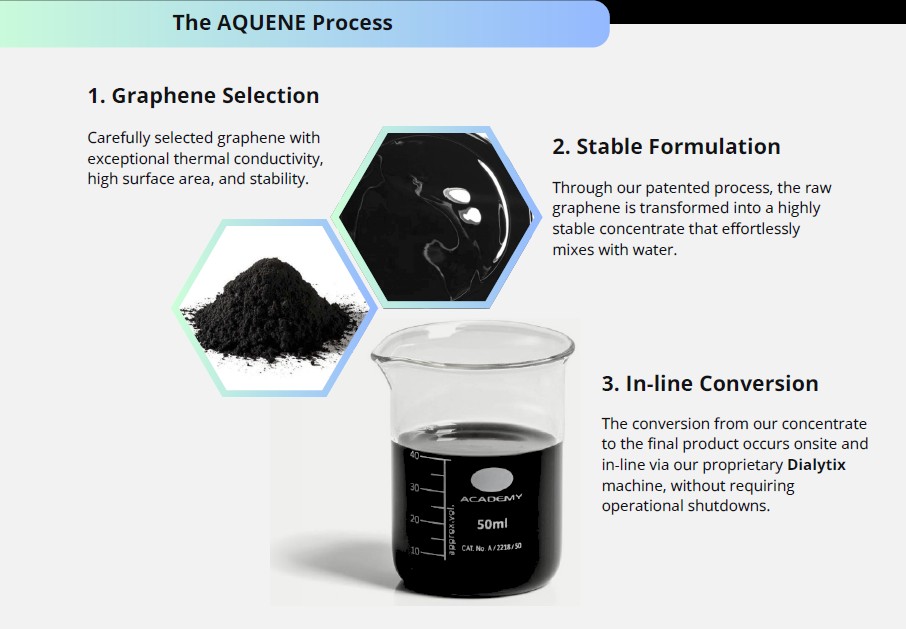
By upgrading the working fluid, Aquene helps chilled-water systems:
- Absorb heat faster
- Transport heat more efficiently
- Release heat more effectively at heat-exchange surfaces
Suitable for:
- HVAC chilled-water loops
- Chiller–AHU systems
- District cooling and industrial closed-loop systems
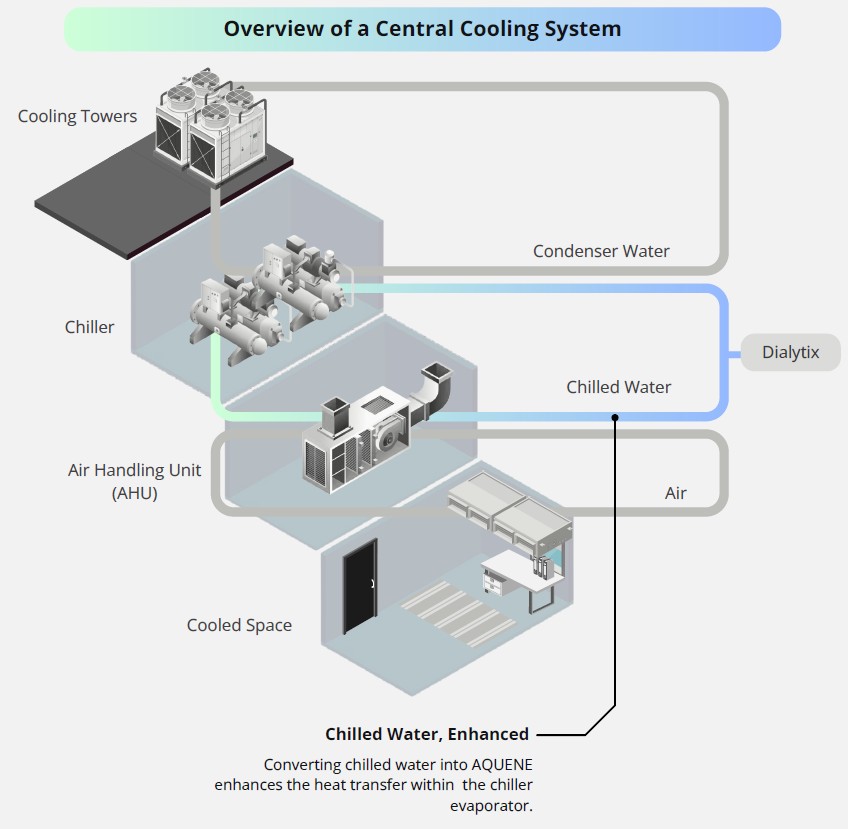
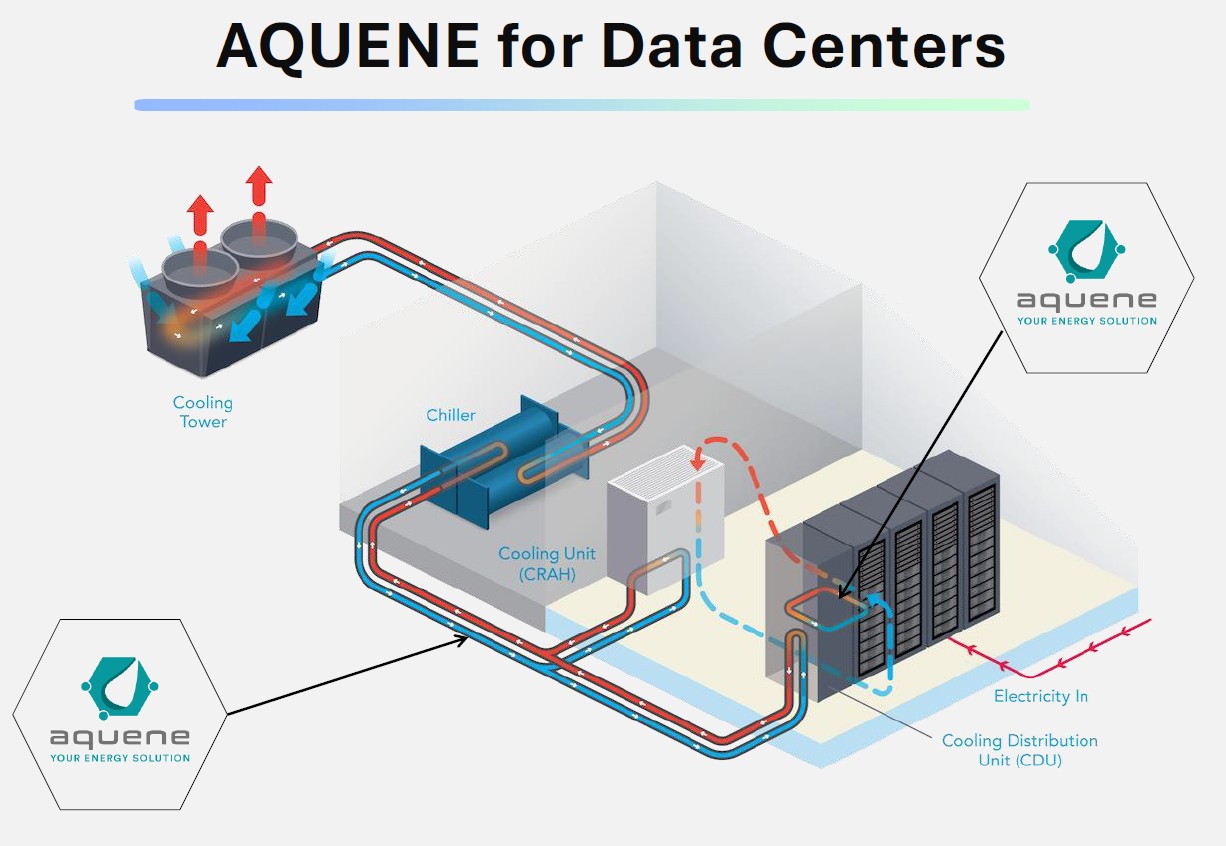
- Water-cooled data centres
Physical & Chemical Properties (Technical Reference):
Property | Value |
Appearance | Black liquid, odourless |
Particle size | ~500 nm |
Operating temperature | 4 – 80 °C |
Density @ 20 °C | 998.7 kg/m³ |
Viscosity @ 20 °C | 1.0809 mPa·s |
pH | 8.0 – 9.0 |
Heavy metals (Zn, Ni, Pb, Mn) | Below detection limits |
Key Implications
- Water-like flow behaviour
- Pump-friendly
- Compatible with HVAC materials
Competitive Advantages:
Versus Water
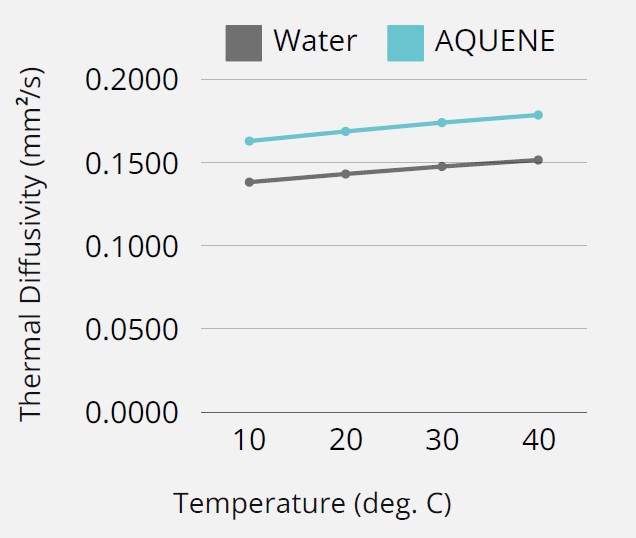
- Higher thermal conductivity
- Better convective heat transfer
- Lower compressor energy
- Reduced carbon footprint
Versus Other Nanofluids
- Designed specifically for closed-loop HVAC systems
- Superior graphene stability
- Effective at low concentrations
- Proven long-term field performance
Benefits & Performance
Aquene delivers:
- Improved heat-transfer efficiency across chilled-water systems
- Lower chiller and pump energy consumption
- More stable supply and return temperatures
- Better performance under partial load conditions
- Long-term stability and HVAC-material compatibility
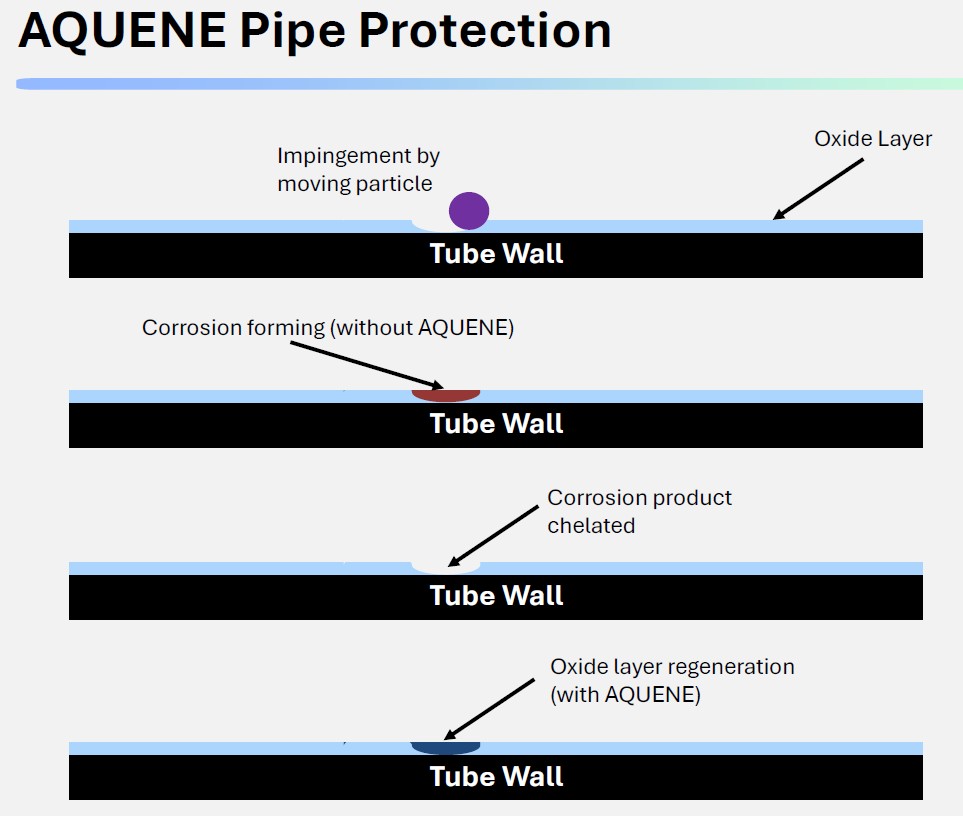
- Regeneration of harder and more resilient oxide layer inside the pipe, providing protection against corrosion and erosion.
- Operating temperature: 4–80°C
- pH: 8.0–9.0
- Water-like density and viscosity for pump-friendly behaviour
- Radiant+ (enhanced heat-exchange surfaces)
- MaxR100 (internal refrigerant efficiency)
Value Preposition:
- ROI is less than 3 years
- Reduces need for water treatment
- Safe & non-toxic
How Aquene™ Works
Aquene improves efficiency by enhancing heat transfer at the molecular / nano scale, without changing equipment design.
1) Improved Heat Absorption & Release
Aquene uses functionalised graphene nanoparticles dispersed in water via proprietary processing. Graphene thermal conductivity up to 5000 W/m·K (vs water ~0.6 W/m·K). Graphene’s high thermal conductivity results in
• Increased effective thermal conductivity of the fluid
• Enhanced convective heat transfer inside pipes and heat exchangers .
What this delivers:
- Faster heat pickup at coils and AHUs
- Reduced temperature differentials across the system
- Same cooling output with less energy input
2) Heat Transfer Enhancement Mechanisms
AQUENE improves system performance through multiple synergistic effects:
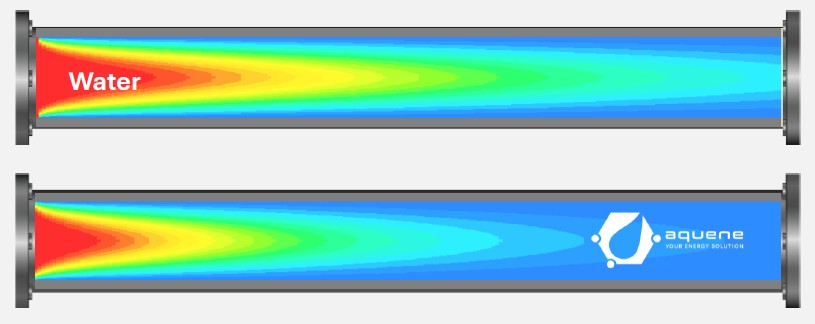
- Boundary layer disruption: Nanoparticle motion reduces thermal resistance at tube walls
- Extended thermal entrance region: Maintains higher heat transfer coefficients
- Flow behaviour improvement: Promotes earlier transition from laminar to turbulent flow at lower Reynolds numbers
These effects are most pronounced at:
- Chiller evaporators
- AHU cooling coils
- Heat pump heat exchangers
3) System-Level Impact
As a result:
- Heat is absorbed and rejected more efficiently
- Compressors reach setpoints faster
- Compressor runtime and lift are reduced
- Electrical energy consumption is lowered
Measured energy savings:
- Up to ~15% at chiller level
- 15–20% system-level savings observed across live projects
4) Improved Flow & Pumping Efficiency
Better heat transfer means the system can achieve the same cooling effect with less flow demand, helping reduce pump energy—especially in large buildings and data centres with long pipe runs.
5) More Stable System Temperatures
Aquene supports thermal stability by improving heat distribution across AHUs and circuits—reducing fluctuation under variable load and helping maintain consistent supply/return temperatures.
Field performance reference:
- Up to ~15% chiller-level energy reduction
- 15–31% system-level savings observed across live projects (application-dependent)
Credibility & Installed-Base Validation
- Deployed across Asia, Middle East, Europe, and Australia
- Applications include hospitals, universities, hotels, malls, industrial plants, and data centers
- Recorded savings: 15–20%
- Recognitions:
- Winner – Ras Al Khaimah Energy Innovation Competition
- Top-10 Finalist – CapitaLand Sustainability Challenge
There are fourteen AQUENE-completed and on-going projects in Malaysia, Singapore, UAE, Australia, India and Scotland Projects. And many others in the pipeline.
Why Better Heat-Transfer Fluids Reduce Energy Use
When the working fluid transfers heat more efficiently:
- Chillers operate at lower lift
- Pumps consume less power
- AHUs and control valves respond more smoothly
- Overall system COP improves
This translates into:
- Lower electricity consumption and peak demand
- Improved reliability and longer equipment lifespan
- Continuous, system-wide savings (not limited to one component)
How Aquene™ Is Implemented
Aquene is introduced into existing closed-loop systems with minimal disruption:
- Compatible with standard HVAC closed-loop materials
- No equipment replacement required
- Can be implemented during live operation.
- Designed for long-term use in sealed systems
System & fluid management (for long-term reliability):
- Managed deployment approach (baseline → retrofit → validation)
- Performance verification aligned to IPMVP Option B where required
Fields of Application
AQUENE is designed for closed-loop systems where thermal efficiency is critical:
- Central chilled water plants
- Commercial HVAC systems (offices, malls, hotels, hospitals)
- District cooling and heating networks
- Data centers and liquid-cooled facilities
- Industrial process cooling
- Solar PV thermal management
- E-mobility and EV battery cooling
Future and advanced applications include high-density electronics, microprocessor cooling, and other precision thermal management systems.
Frequently Asked Questions
AQUENE is an advanced heat transfer nanofluid designed for closed-loop chilled water and cooling systems. It contains a proprietary blend of graphene-based nanoparticles that enhance thermal conductivity, improve system efficiency, and help reduce energy consumption.
Yes. AQUENE has been tested for material compatibility. It is stable, non-corrosive, and does not harm metals, gaskets, seals, or common system materials when used as recommended.
No. Aquene is a purpose-engineered heat-transfer fluid designed for closed-loop systems (a working-fluid upgrade, not an additive).
AQUENE uses graphene nanoparticles, which possess exceptional thermal conductivity. When properly dispersed, these particles enhance heat transfer within the fluid, leading to improved cooling performance and system efficiency.
No. AQUENE is formulated with advanced dispersion technology to ensure long-term particle stability. Due to this and its small particle size, there is no risk of clogging, sedimentation, or blockage in properly maintained closed-loop systems.
AQUENE is specifically designed for closed-loop systems. Use in open-loop systems like cooling towers is not recommended due to potential dilution and contamination, which can affect performance.
No major modifications are needed. However, the system should be clean to ensure its compatibility with AQUENE. If the system is not maintained prior to dosing, we will conduct a water pre-treatment program that is safe for AQUENE.
Yes. Our service comes together with the dosing of AQUENE, annual maintenance and the measurement of energy performance. AQUENE can be added with minimal downtime. In some cases, our Dialytix equipment is used to assist with dosing if sidestream access is unavailable.
No. AQUENE’s formulation protects the pipes and prevents corrosion or fouling by itself. Additional chemicals can disrupt its stability and are not recommended.
Typically, a few days to one week, depending on system size and access. With sidestream filtration or a dosing pot, conversion is quick. If not available, we can assist with our Dialytix equipment to ensure smooth, efficient dosing.
The operating temperature is 4 - 90C.
Aquene is used as the system’s working fluid according to design and application requirements (closed-loop).
Where required, projects follow baseline and post-implementation validation aligned with IPMVP Option B.
Under normal operating conditions, AQUENE provides long-term stability and performance. We will inspect the quality of nanofluid annually, but the nanofluid itself remains effective for several years without the need for frequent replacement.
Upgrade Cooling Performance at the Fluid Level
In chilled-water systems, the fluid is as important as the equipment. Aquene™ helps you unlock measurable efficiency gains by improving heat transfer where it matters most—inside the closed-loop system.
Contact Radiant Climate Technologies to explore Aquene™ for your HVAC plant, data centre, or industrial closed-loop cooling system.
Better fluid. Better heat transfer. Better system performance.
Explore Related Energy Loss Topics
This problem connects to broader thermal-efficiency challenges across industries: