
What Is Energy Loss?
Energy loss occurs when systems require more power to achieve the same output due to heat-transfer resistance, unstable airflow, poor combustion, or inefficient thermal design.
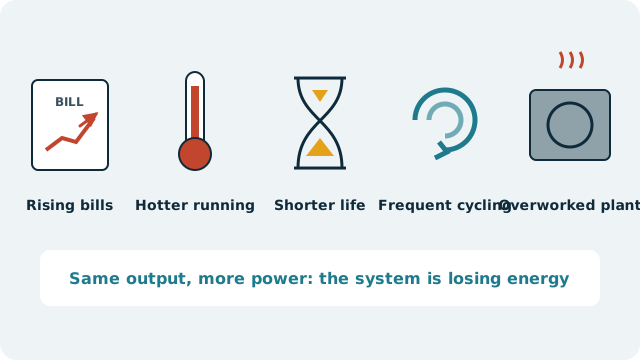
Common signs include:
- Increased electricity or fuel consumption
- Rising operating temperatures
- Shorter equipment lifespan
- Frequent cooling or heating cycles
- Oversized or overworked equipment
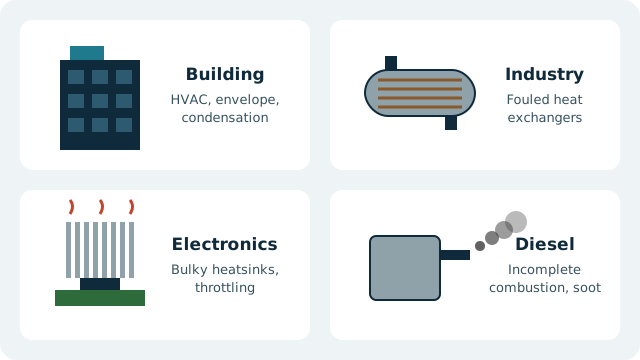
Energy loss is not limited to buildings - it affects industries heat exchanging surfaces, electronics cooling, and diesel-powered systems.
Where Are the Main Areas of Energy Losses?
Building Energy Loss
Buildings lose efficiency through internal HVAC degradation, external heat gain, condensation, and unstable airflow dynamics.
Explore: Building Energy Loss
Explore: Solutions to Building Energy Loss
Industry Heat Transfer Loss
Industrial processes depend on efficient thermal exchange. Fouling, corrosion, or poor surface conductivity reduce heat transfer, forcing higher energy input.
Explore: Industry Heat Transfer Loss
Explore: Solutions to Heat Transfer Loss
Poor Thermal Management in Electronics
Inefficient heat dissipation leads to bulky heatsinks, thermal throttling, and reduced electronic performance.
Explore: Poor Thermal Management in Electronics Leading to Bulky Heatsinks
Explore: Solution to Poor Thermal Management in Electronics Leading to Bulky Heatsinks
Incomplete Combustion of Diesel
Fuel systems lose efficiency when combustion is unstable, producing soot, higher emissions, and reduced power output.
Explore: Incomplete Combustion of Diesel
Why Does Energy Loss Matter?
Across all sectors, hidden inefficiencies create a chain reaction:
- More heat buildup
- Higher cooling demand
- Increased fuel or electricity use
- Greater carbon footprint
Understanding the root causes allows organisations to improve efficiency without major equipment replacement.
What are the Physics Behind Energy Loss?
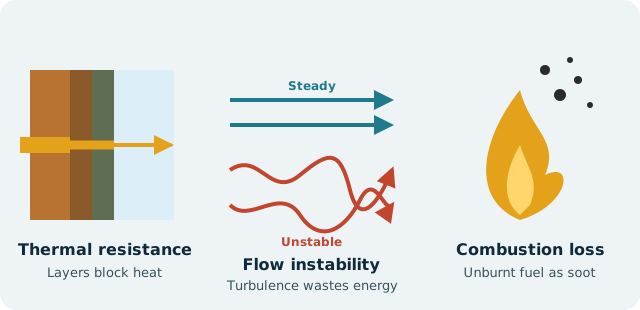
At its core, energy loss is governed by three engineering principles:
- Thermal Resistance — Heat cannot transfer efficiently through materials or fluids.
- Flow Instability — Air, liquid, or fuel movement becomes turbulent or unbalanced.
- Combustion or Operational Inefficiency — Systems consume more energy than required due to suboptimal reactions or controls.
These mechanisms appear differently across buildings, industry, electronics, and engines — but share the same underlying physics.
1. Thermal Resistance - The Hidden Barrier to Efficiency
When surfaces accumulate fouling, corrosion, or low-conductivity layers:
- Heat exchangers lose performance
- Electronics require larger heatsinks
- Industrial systems consume more power
Improving thermal conductivity and surface interaction reduces energy demand while improving reliability.
2. Flow Instability - When Movement Creates Energy Waste
Airflow, fluid flow, or refrigerant flow that fluctuates excessively forces systems into reactive operation.
Examples include:
- HVAC airflow imbalance
- Human traffic disturbing refrigeration airflow
- Coolant turbulence in electronics
- Fuel-air mixing instability in engines
Stabilising flow conditions allows systems to operate closer to steady-state efficiency.
Related hubs:
Building Energy Loss
Incomplete Combustion of Diesel
3. Combustion & Reaction Inefficiency — Fuel Energy Not Fully Utilised
In diesel engines, incomplete combustion reduces usable energy output.
Engineering impacts include:
- Carbon buildup
- Increased fuel consumption
- Higher emissions
- Reduced engine lifespan
Optimising combustion chemistry and fuel interaction improves energy conversion efficiency.
Related hub:
Incomplete Combustion of Diesel
How to Explore the Energy Loss Knowledge Network?
Use this pillar to navigate deeper into specific problem areas:
- Building Energy Loss
- Industry Heat Transfer Loss
- Poor Thermal Management in Electronics Leading to Bulky Heatsinks
- Incomplete Combustion of Diesel
Each page provides engineering-level insight into the causes of inefficiency and the pathways toward smarter energy performance.
Speak to Energy Efficiency Specialist
Explore which industries these energy losses impact.