
What Building Owners & Facilities Managers Want
As building owners and facility managers, you want:
- Energy savings without replacing equipment
- Solutions that work on existing HVACR systems
- Lower compressor stress and fewer breakdowns
- Reduced maintenance and extended equipment life
- Fast ROI with minimal disruption
They need a solution that restores internal system efficiency, not just external performance.
MaxR100® — A Smarter Internal HVACR Efficiency Solution
MaxR100® is a refrigerant system performance enhancer designed to work inside the sealed HVACR and refrigeration circuit.
Introduced into the refrigerant or compressor oil loop, MaxR100 chemically interacts with internal metal surfaces to:
- Remove oil fouling
- Reduce internal friction
- Restore heat-transfer efficiency
- Lower compressor workload
Unlike coatings or mechanical retrofits, MaxR100 works during normal system operation, without system modification or replacement .

How MaxR100 Works
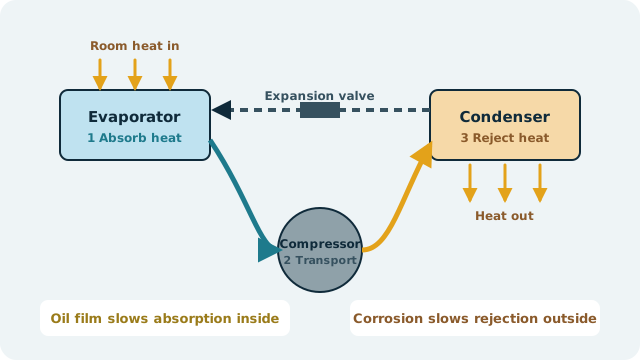
MaxR100 restores HVACR efficiency by addressing internal losses that external solutions cannot reach.
Internal Surface Rehabilitation
When injected into the system, MaxR100:
- Bonds to internal metal surfaces
- Lifts and releases oil fouling
- Prevents oil from re-adhering to heat-exchange walls
- Allows oil to return to the compressor sump
This restores clean, thermally active internal surfaces without flushing or disassembly.
Improved Internal Heat Transfer
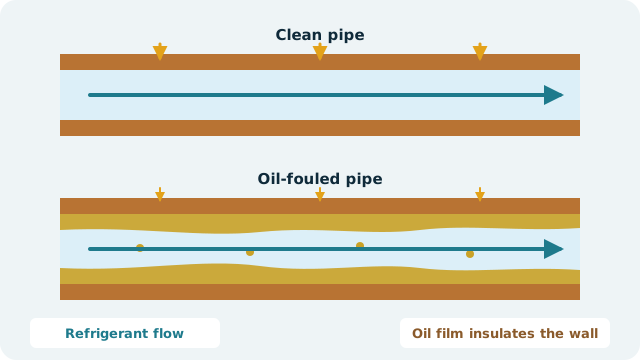
Oil films act as thermal insulation.
By removing oil fouling:
- Heat transfers more efficiently between refrigerant and metal
- Evaporation and condensation improve
- Less temperature lift is required from the compressor
The system reaches cooling capacity with lower energy input.
Reduced Friction & Mechanical Losses
MaxR100 conditions internal metal surfaces to:
- Reduce compressor friction
- Lower mechanical resistance
- Decrease electrical power draw
This results in quieter operation, lower amperage, and reduced mechanical stress.
What savings has MaxR100 achieved in real projects?
Nine MaxR100 projects from 2008 to 2024, in the USA, Australia and China, recorded energy savings or efficiency gains of 9% to 35% in rooftop units, split systems, refrigeration and a 1,100-ton chiller. Site owners are not named.
- 26.6–34.9%energy
School district — Las Vegas, Nevada, USA (2008)
Four 3-ton rooftop heat pumps.
- 22.4–31.6%cooling capacity
Restaurant — Jacksonville, Florida, USA (2009)
Five Carrier rooftop package units, 62.5 tons; evaporator enthalpy method.
Read the full case study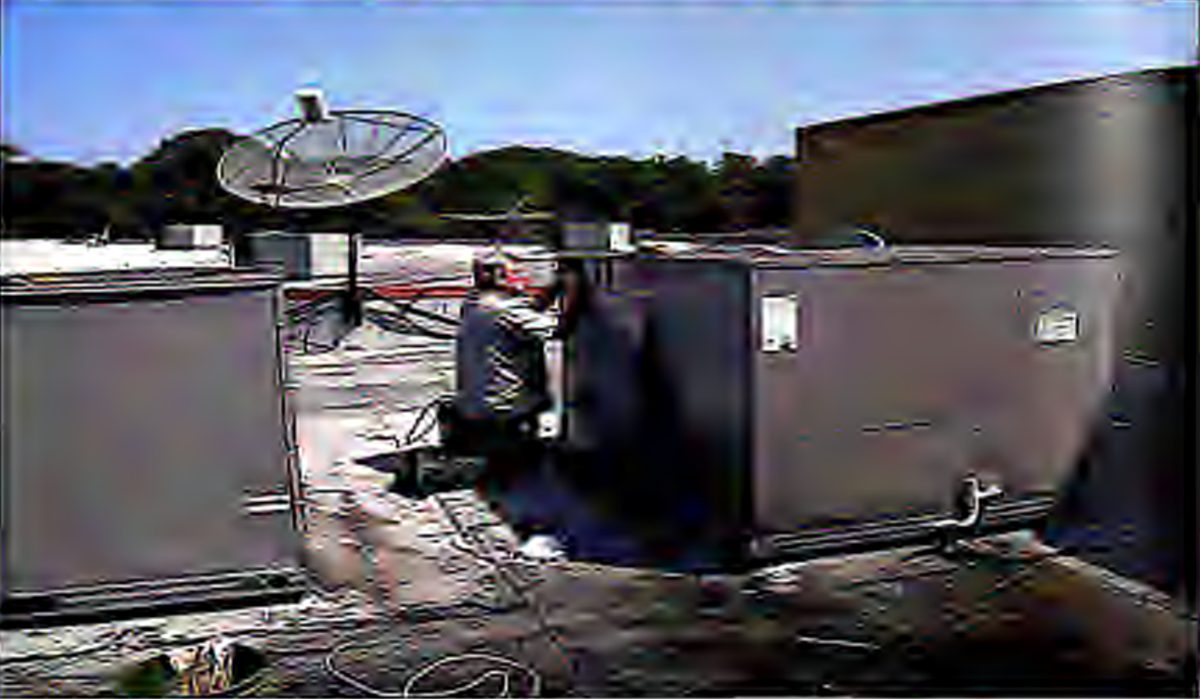
- 16.8%energy
Community centre — Lovettsville, Virginia, USA (2009)
York 4-ton air conditioner / heat pump; project of a regional government energy advisory group.
- 24.42% / 21.28%cooling energy cost
Two retail stores — Midwest USA (2011)
Store A: six HVAC/R units, 20.75 tons. Store B: two units, 10 tons. Payback about six months.
Read the full case study - 32.14% / 17.48%energy
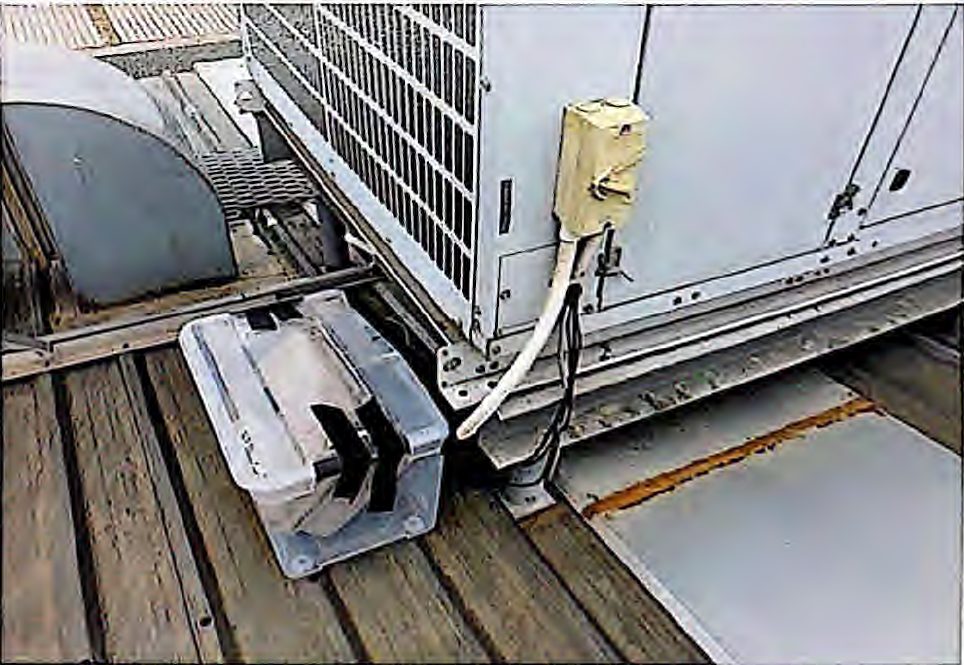
Municipal depot — Victoria, Australia (2021)
Temperzone OPA225RKT 6.5-ton and OPA405RT 12-ton package units.
- 14.10%kW per TR · COP +16.67%
Consumer-goods manufacturing plant — Yangzhou, China (2022)
Trane CVHG 1,100-ton centrifugal chiller, R123, 10 years old.
Read the full case study - 15% → 18%whole-store electricity
Steakhouse restaurant — Beverly Hills, California, USA (2023–24)
HVAC and refrigeration totalling 77.5 tons; 15% in 2023, 18% in 2024.
- 12%whole-store energy, annual
Steakhouse restaurant — San Diego, California, USA (2024)
Two Trane 85-ton package units and four 5-ton Copeland compressors.
- 9% / 28%whole store / HVAC-R
Korean barbecue restaurant — Sacramento, California, USA (2024)
Two Fujitsu 4-ton cooler/freezer units and six Lennox 5-ton rooftop units.
All project case studies Combined savings and payback in Singapore
Why Internal Efficiency Restoration Saves Energy
When internal heat transfer and mechanical efficiency improve:
- Compressor runtime shortens
- Discharge pressure and temperature drop
- Electrical demand decreases
- Cycling frequency reduces
Documented installations show:
- Guaranteed minimum energy savings of ~10%
- Typical savings of 16–35%, depending on system condition
- Lower compressor amperage and improved humidity control
Many systems show noticeable improvements immediately, with full stabilisation over several weeks .
Why MaxR100 Complements Other HVACR Efficiency Solutions
MaxR100 addresses internal refrigerant-side inefficiencies, while solutions like:
- Coil cleaning
- Radiant+ heat-transfer coatings
- Control optimisation
Address external and system-level efficiency.
Together, they form a complete HVAC energy-saving strategy, rather than competing solutions.
Where MaxR100 Is Used
MaxR100 is suitable for a wide range of HVAC and refrigeration systems:
Building HVAC
- Commercial HVAC systems
- Rooftop packaged units
- Split, VRF, and VRV systems
- Air-cooled and water-cooled chillers
Refrigeration
- Cold rooms and cold storage
- Supermarket refrigeration
- Food and pharmaceutical cooling
Industrial & Specialised Cooling
- Process cooling systems
- Data centre cooling
- Industrial heat pumps
Frequently Asked Questions
What is MaxR100?
A refrigerant system performance enhancer that restores internal heat-exchange efficiency and reduces energy consumption.
Can it be used on existing HVACR systems?
Yes. MaxR100 is designed specifically for retrofit applications.
Is it safe for HVACR equipment?
Yes. It is compatible with common refrigerants and does not alter system tolerances.
Does it require reapplication?
Typically no. MaxR100 is designed as a one-time treatment.
Can it be combined with other efficiency measures?
Yes. It complements coil cleaning, coatings, and maintenance best practices.