
Pentaguard Nano-Ceramic Coating System
Reduce Heat Gain. Lower Cooling Energy. Improve Building Comfort.
The Hidden Heat Problem in Buildings
In many buildings, especially in tropical and high-solar regions, excessive heat doesn’t come from inside - it comes through the building envelope.
Roofs, walls, and exposed structures absorb large amounts of radiant heat due to:
- Direct solar radiation
- Heat retention in concrete, metal, and façade materials
- Radiant heat transfer through roofs and walls
- Poor thermal resistance of conventional finishes
This leads to higher indoor temperatures, longer air-conditioning runtime, rising electricity bills, and reduced occupant comfort.
In many cases, cooling systems are working harder simply to remove heat that should never have entered the building.

What Building Owners and Operators Want
As building owners, developers, and facility managers, you want:
- Lower cooling energy consumption without major renovation
- Passive solutions that reduce heat before it enters the building
- Improved indoor comfort and thermal stability
- Protection for buildings exposed to harsh sun and heat
- Long-lasting, low-maintenance solutions that support ESG goals
They need a way to control heat at the surface level, not just remove it mechanically.

Pentaguard — A Smarter Exterior Heat-Control Solution
Pentaguard is a Japanese nano-ceramic heat-shielding and thermal-insulation coating system designed to reduce heat absorption on building exteriors.
Unlike heat-conductive coatings, Pentaguard works by:
- Reflecting radiant heat
- Limiting heat absorption into building materials
- Slowing heat transfer into interior spaces
It is a passive, retrofit-friendly solution that reduces cooling demand and improves thermal comfort without altering building structure or systems .
Benefits & Performance
Pentaguard delivers multiple benefits:
- Significant reduction in surface and internal temperatures
- Lower cooling energy consumption
- Improved occupant comfort and equipment reliability
- Anti-condensation and anti-static properties
- Contribution to noise insulation
- Non-flammable, non-hazardous, water-based formulation
- Long service life, typically over 10 years
How Pentaguard Works
Pentaguard reduces heat load through surface-level thermal control, not mechanical cooling.
1. Radiant Heat Reflection
Pentaguard contains densely packed hollow nano-ceramic spheres of 5μ-50μ size that reflect a broad spectrum of radiant heat before it is absorbed by the substrate.
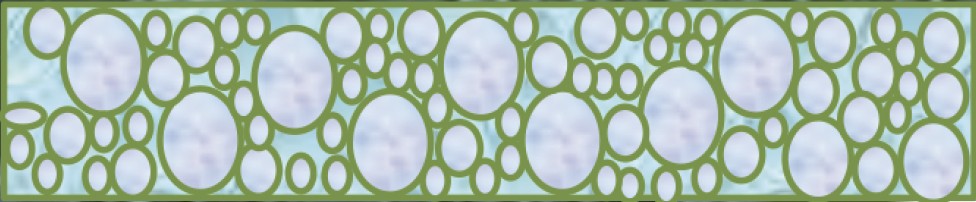
This significantly reduces surface heat build-up under sun or radiant exposure.
2. Thermal Insulation Effect
The nano-ceramic structure forms a micro-insulating layer that:
- Slows heat conduction through roofs and walls
- Reduces internal temperature rise
- Limits heat retention in building materials
Unlike light-activated or photocatalytic coatings, Penta Gard performs consistently even in shaded or enclosed areas.
Proof That Heat Reduction Is Achieved
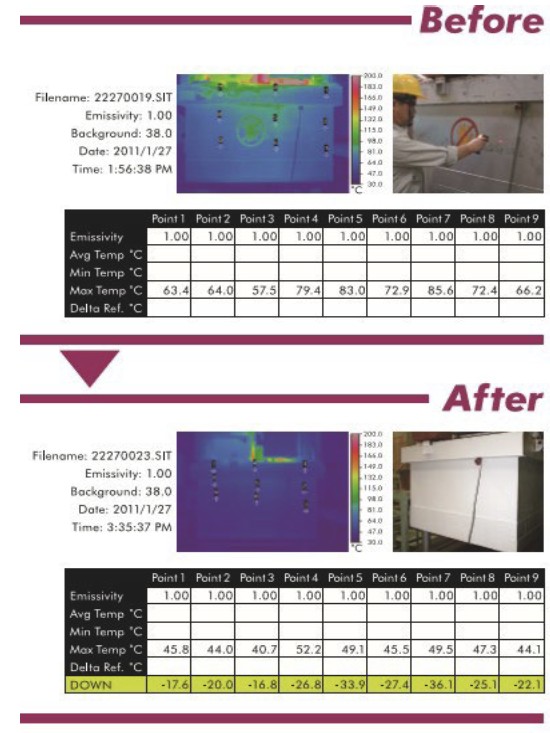
In Indonesia, a field demonstrations and thermal imaging show:
- Clear temperature differences between coated and uncoated surfaces
- Surface temperature reductions exceeding 30 °C in certain applications
A documented industrial case recorded:
- Furnace surface temperature reduced from 85.6 °C to 49.5 °C after application
Lower surface temperatures directly translate into reduced ambient heat load and lower cooling energy demand .
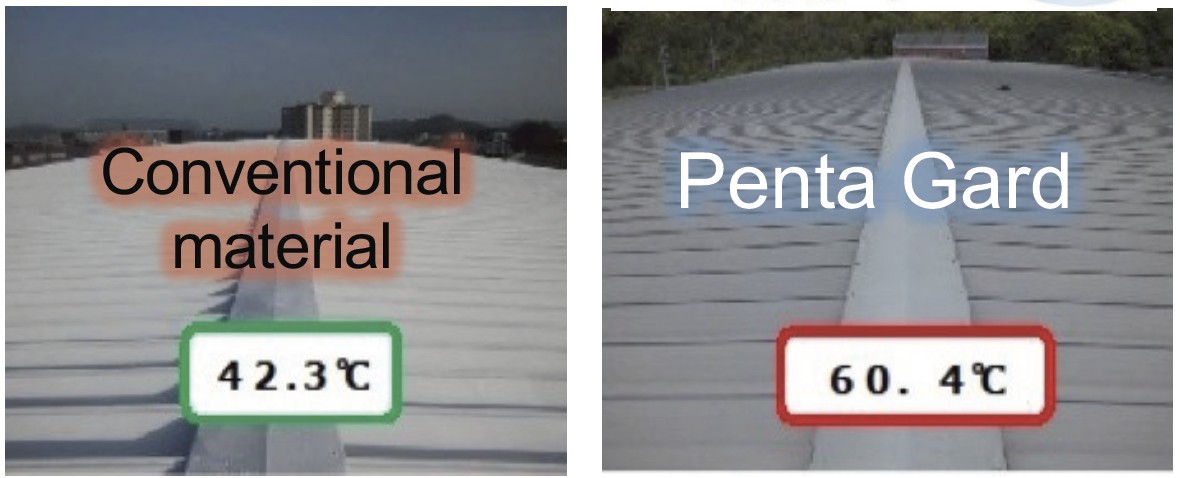
Even a simple coating application can prove that the temparatue diffrence a conventinal heat dissipation material
and Pentaguard applied on a roof surface and inside of a building.
Customers, the Proven Track Records
We have the proven track record, the following well known international customers and more than 20 agencies in Japan.
- Kikkoman
- The University of Tokyo
- Narita Airport
- JR East
- Imperial Hotel, Tokyo
- BIG Power Supplies
- PPG
- Comex
Why Reducing Heat Gain Saves Energy
When less heat enters a building:
- Indoor temperature rises more slowly
- Air-conditioning systems cycle less frequently
- Peak cooling demand is reduced
- Overall electricity consumption drops
This is especially impactful for:
- Buildings in tropical climates
- Warehouses and large-roof structures
- Data centres, where cooling energy is a major operating cost
How Pentaguard Is Applied
Pentaguard is applied like a conventional water-based coating:
- Surface preparation and cleaning
- Application by brush, roller, or spray
- Ambient curing with no special heat treatment
Typical application details:
- Coverage: ~25–30 m² per 14 kg
- Matte, non-gloss finish
- Can be applied over existing waterproof coatings if required
Where Pentaguard Is Applied
Pentaguard is suitable for a wide range of exterior and heat-exposed surfaces:
Buildings & Infrastructure
- Roofs and external walls
- Commercial, residential, medical centers and institutional buildings
- Warehouses and logistics facilities
Data Centres & High-Heat Facilities
- AI data centres and server rooms
- Supporting infrastructure exposed to heat load
“iCT provides world-wide solutions to AI’s data center heat related problems by providing retrofittable, cost effective and proprietary nano ceramic thermal dissipation coating technology from JAPAN.”
Industrial & Specialised Environments
- Factories and production facilities
- High-temperature surfaces and industrial structures
- Marine, container, and transport infrastructure
Marine Environments
- Ships and Containers
- Off-shore and coastal buildings
- Transport infrastructure
Frequently Asked Questions
A nano-ceramic heat-shielding and thermal-insulation coating designed to reduce radiant heat absorption on building and industrial surfaces.
A photocatalyst is a substance that generates catalyst activity using energy from a light. Titanium dioxide is the typical material used. However, it will volatilize after 2 to 5 years, and condensation will occur where mold will grow. It also requires the light where it will be ineffective in a dark location.
Pentaguard has the world's highest nano ceramic content (over 90%) and, thanks to its unique technology, provides superior heat-blocking performance compared to other products.
From -100 C to 120 C of radiant heat.
Pentaguard reflects and blocks heat instead of conducting it away, making it ideal for roofs, walls, and building envelopes.
The coating itself is not waterproof, but it can be applied over waterproof systems, such as Radiant+ Coating System from Radiant Climate Technologies.
It can be dyed in various light matte colors. Dark colors are not available as it contains white ceramic materials.
It has a matte finish. Due to the structure of the product, it does not get glossy.
The application process is same as a general water
of based paint. 1 container is 14 kg and gives 25sqm to 30 sqm surface coverage. It cannot be painted on polypropylene and teflon surfaces.
Yes. It is water-based, low-VOC, non-flammable, and non-hazardous.
Typically more than 10 years, with reapplication possible if needed.
Explore Related Energy Loss Topics
This problem connects to broader thermal-efficiency challenges across industries:
Explore the industries these solutions serve
Reduce Heat Before It Becomes a Cooling Problem
Instead of spending energy removing unwanted heat, stop heat from entering the building in the first place.
Contact Radiant Climate Technologies to learn how Pentaguard Nano-Ceramic Coating System can reduce heat gain, lower cooling energy use, and improve long-term building performance.
Reflect heat. Reduce energy. Improve comfort.
Explore the industries this solution serves
Explore All Energy Efficiency Solutions
HVAC Performance Solutions
- Heat exchanger efficiency improvement
- Energy efficiency improvement in refrigeration circuit
- Heat Transfer Fluid for chiller
- High Efficiency Refrigeration
- AI Driven HVAC Optimization System
Energy Efficiency Building Envelop and Hygiene Solutions
Industrial Heat Transfer