
Radiant+ E3 Coating System
Restore HVACR Efficiency. Reduce Energy Consumption.
Extend Equipment Life.
The Hidden Problem in HVACR Systems
HVACR systems don’t suddenly become inefficient—they slowly lose performance over time.
As condenser and cooling coils age, they suffer from:
• Corrosion and oxidation on aluminium and copper surfaces
• Dust, biofilm, and contaminant build-up
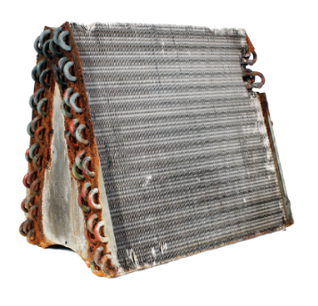
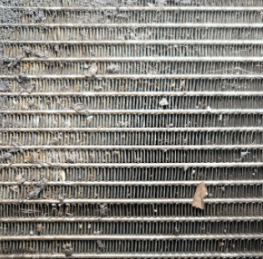
• Water retention from condensation
• Reduced airflow and heat transfer
The result is higher energy bills, longer compressor runtime, declining EER/COP, and premature equipment aging—even though the system is still running.
What Building Owners Are Looking For
As building owners and facility managers, you want:
• Lower HVACR energy consumption without replacing equipment
• A proven way to restore performance, not just clean coils
• Practical solutions to meet ESG and sustainability targets
• Longer asset life and reduced maintenance costs
You need a solution that improves heat transfer, not just appearance.
Radiant+ E3 Coating System — The Smarter Solution
Radiant+ E3 Coating System is a water-based, thermally conductive coating designed to restore and enhance heat transfer on HVACR and refrigeration coils.
Applied directly to aluminium and copper heat-exchange surfaces, Radiant+ E3 rehabilitates degraded coils so they perform like new—and in many cases, even better.
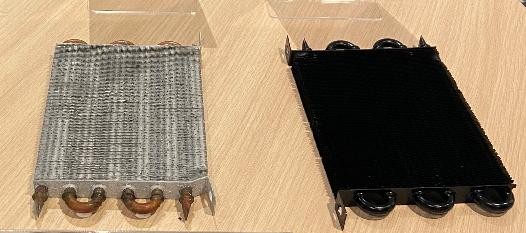
It is suitable for existing systems (retrofit) and new installations, with minimal downtime.
How Radiant+ E3 Coating System Works
Radiant+ E3 improves HVACR efficiency by enhancing all three heat-transfer mechanisms:
Improved Heat Conduction
Corrosion and fouling create thermal resistance.
Radiant+ E3 forms an ultra-thin (10–15 micron), thermally conductive layer that allows heat to move more efficiently from refrigerant to air—reducing compressor effort and energy use.
Improved Airflow & Convection
Rough, corroded fins disrupt airflow.
Radiant+ E3 Coating System:
- Smooths damaged surfaces
- Reduces air-side resistance
- Keeps fin passages cleaner for longer
Improved airflow means fans and compressors work less for the same cooling output.
Superior Water & Condensate Management
- Water films act as thermal insulation.
- Radiant+ E3 Coating creates a super-hydrophobic surface, allowing condensate to shed instantly. This keeps fins dry, improves heat exchange, and reduces corrosion and biofouling.
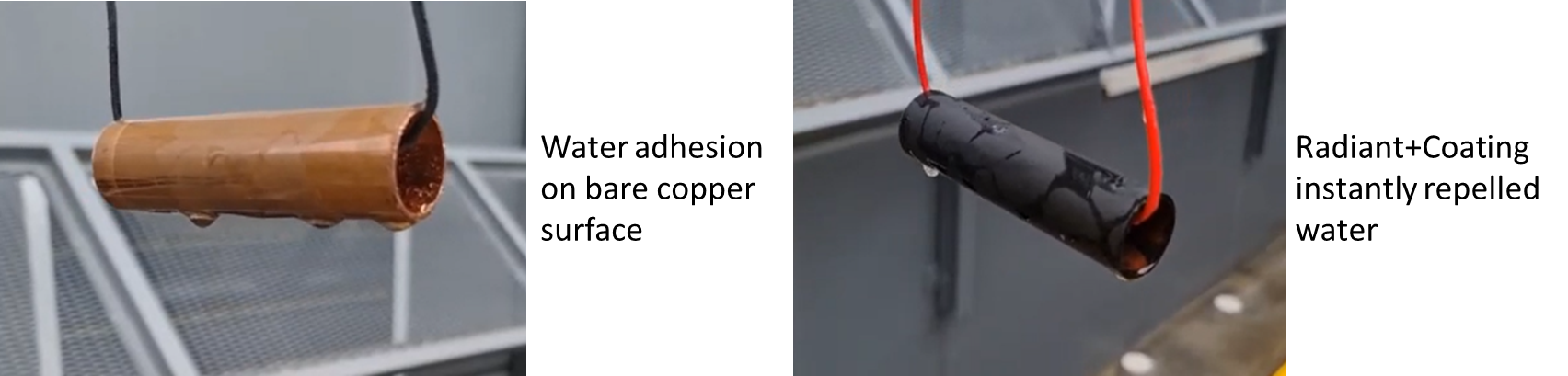
Tests of Radiant+ E3 Coating Heat Transfer Capability
Test of Heat Transfer Capability (Same Heat Sink Size)
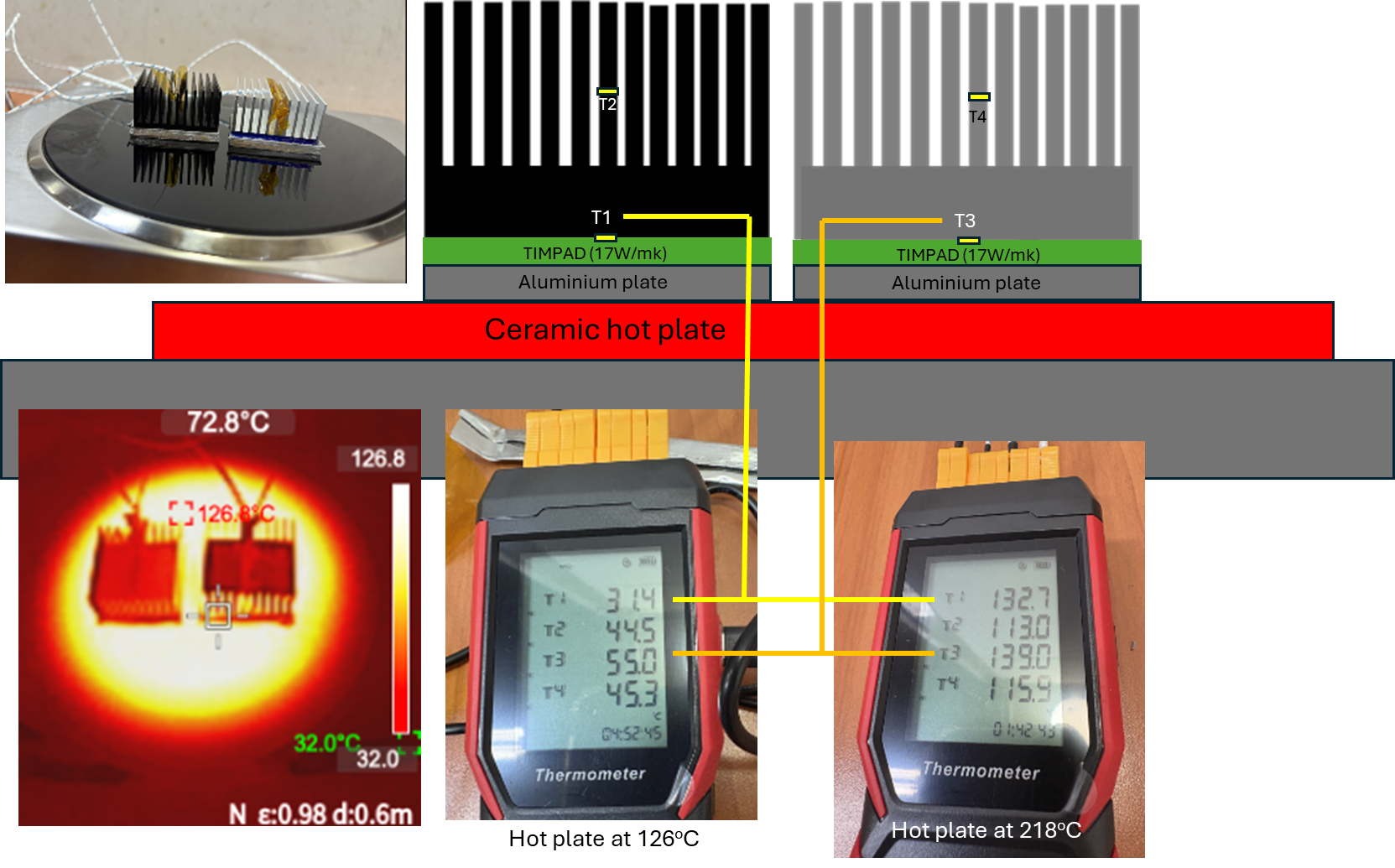
The TIMPAD temperature under coated heatsink is significantly lower than TIMPAD temperature under bare heatsink.
Coated heatsink dissipate heats significantly better than bare heatsink.
Test of Heatsink Miniaturization
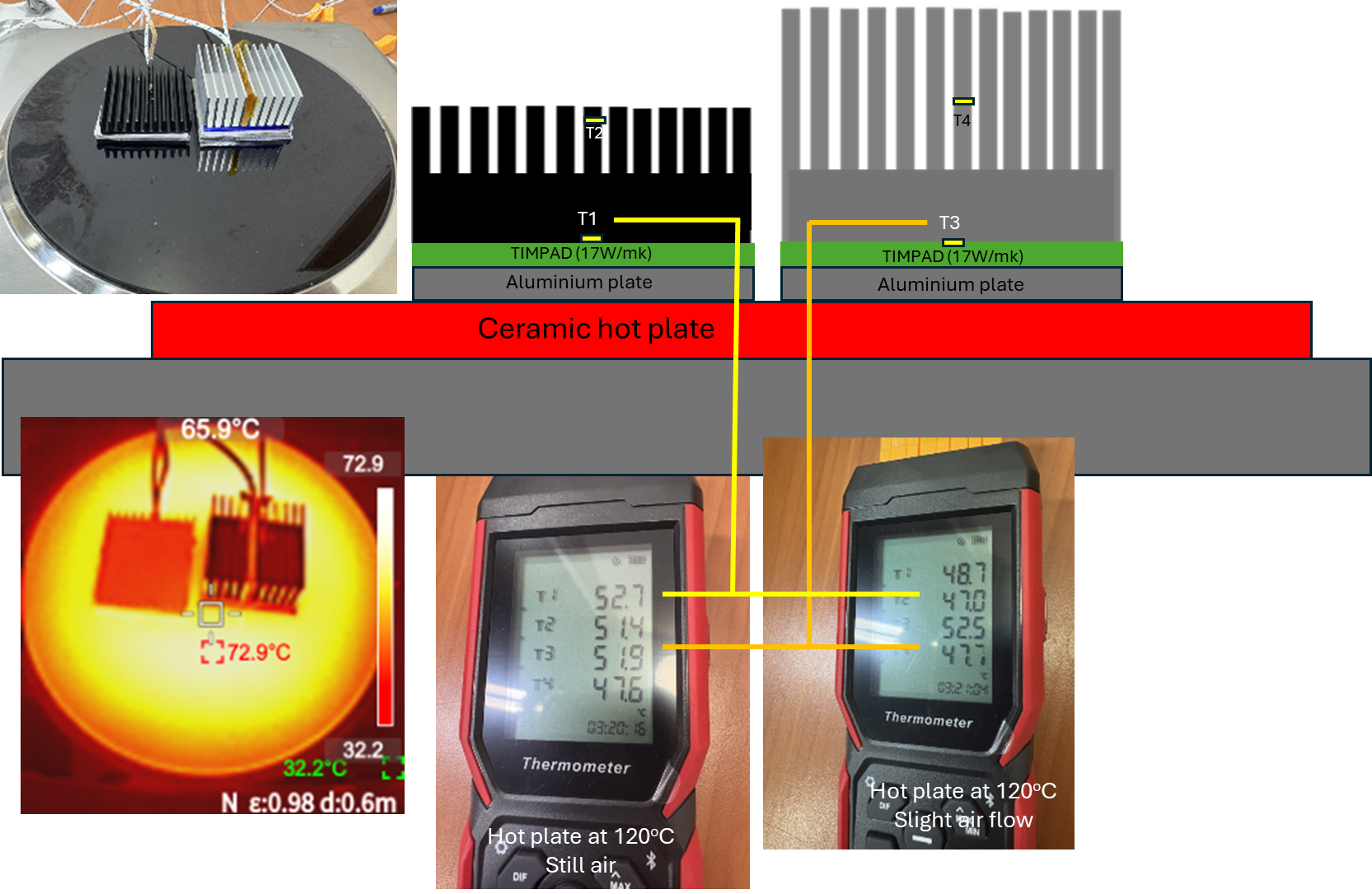
TIMPAD temperature under coated but shorter heatsink is close to TIMPAD temperature under bare heatsink (despite of half-fin lenght-heatsink). Even lower with slight airflow.
Coated smaller heatsink allows miniaturization of heatsinkWhy Better Heat Transfer Means Lower Energy Bills
When heat transfer improves:
- Compressor runtime shortens
- Discharge pressure drops
- Fan power decreases
- System efficiency (EER/COP) increases
Independent testing and real-world installations have shown:
- Restoration of lost efficiency
- Measurable coil temperature reduction
- Energy savings of 6 - 30%, depending on system type and condition
Impact Area | Performance Indicator | Typical Results / Range | |
|---|---|---|---|
1 | Energy Efficiency | Reduction in HVAC electricity use | 6% – 30% energy savings |
2 | Carbon Reduction | CO₂ emissions avoided | 0.3 - 0.9 tons / system / yr (aver) |
3 | Resource Efficiency | Extended asset lifespan | +3–5 years average |
4 | Material Safety | Water-based. VOC free | 100% non-toxic formulation |
5 | Payback Period | ROI through energy saved | 12–24 months typical |
How Radiant+ E3 Is Applied
The Radiant Coating System process involves three key stages:



Why partner with Radiant Climate Technologies?
Radiant Climate Technologies (RCT) specialises in HVACR energy-efficiency solutions, not just coatings. By partnering with RCT, building owners gain:
- Proven heat-transfer expertise
- Proper application control for real performance gains
- Energy measurement and verification support
- Alignment with ESG and carbon-reduction goals
- Extended HVAC asset lifespan without replacement
Frequently Asked Questions
Radiant+ Coating System is a direct to metal, water-based acrylic paint has been specifically formulated to adhere to aluminium and copper. It comprises of several unique raw materials incorporating a combination of proprietary formulation and blending IP that include activated resins, proprietary catalysts and proprietary blending techniques
Generally, when working on the ground without using lift or scaffolding, 4 - 6 fin-coils of up to 3 sqm in area can be coated on both sides in 8 hour-work.
Yes. This is for safety reason. Hence we will closely coordinate with the owners of the HVACR systems to work on convenient date and time for the shut-down.
By coating Radiant+ Coating System on the surface of the fin-coils of the condenser unit and the cooling coils, Radiant+ Coating System
- enhances the heat transfer by conduction and convection with its proprietory formulation with high density free charge carriers of high mobility,
- It also improves airflow and heat exchange after the cleaning.
- The hydrophobicity of the coating reduces contamination, water retention and/or icing on exposed surfaces/coil fins. Results in maintained heat transfer efficiency over longer periods.
With enhanced heat transfer, the refrigeration cycles and the heat exchanges for cooling/warming become more efficient, empowering the energy efficiency.
The energy consumption is measured generally with
- A wifi/cellular energy meter is connected to the power supply of the system to measure the energy consumption.
- A thermo-hygrometer is used to measure the ambient temperature to register the weather condition.
- A therm-hygrometer is placed each at the return air and supply air to measure the heat energy of the flowing air through the cooling coil. Or thermometer is place each at the return water and supply water of the chiller. This is to measure the cooling load.
- The coefficient of performance of the system is then computed against the ambient temperature.
The protective nature of the coating is expected to last for more than 5 years. Generally longer is expected.
Explore Related Energy Loss Topics
This problem connects to broader thermal-efficiency challenges across industries:
© 2026 Build with Thrive Architect.