
Building energy efficiency engineering in Singapore
Turn hidden building energy loss into measurable savings
Buildings waste energy in their cooling plant, their lighting, their roofs, walls and windows, and in how energy is managed and supplied. Radiant Climate Technologies finds where your building is losing energy, then combines the right technologies into one measured upgrade, without replacing equipment that still has life in it.
HVAC and refrigeration
Restore lost heat transfer and run the plant to real demand.
Smart LED lighting
Light only where and when people need it.
- Bluetooth-mesh LED lighting with easy, smart control>70%
- Microwave motion sensing
- Low-wattage fittings
Building envelope and passive cooling
Keep solar heat and condensation out, so there is less to cool.
Energy management and renewables
See where energy goes, control it, and generate your own.
- Building energy management: smart thermostats, sensors and energy meters
- Occupancy, temperature and humidity monitoring
- Solar PV, solar water heating and grid-interactive systems
What is building energy efficiency?
Building energy efficiency means delivering the same cooling, comfort and process performance with less electricity or fuel, by removing the losses in HVAC, refrigeration, lighting and the building envelope.
The payoff is lower operating cost, more reliable plant, longer equipment life and lower carbon emissions. There are three ways to get there:
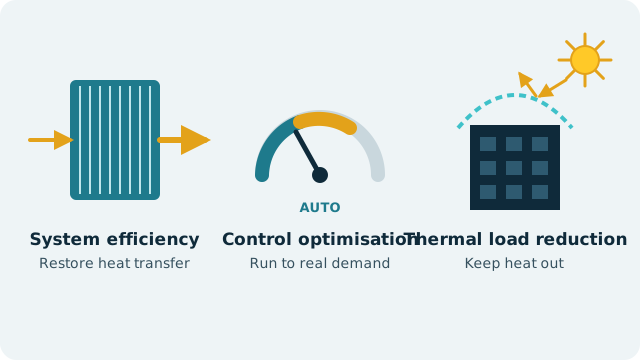
System efficiency
Restore heat transfer in coils, heat exchangers and refrigerant circuits so compressors and fans do less work for the same cooling.
Control optimisation
Tune chiller sequencing, setpoints and airflow, increasingly with AI, so plant runs to real demand instead of overcooling.
Thermal load reduction
Keep heat out in the first place with passive cooling coatings, UV window film and envelope treatments.
Why do buildings lose energy?
Most building energy loss is gradual. Coils oxidise, oil fouls refrigerant circuits, airflow is restricted, the sun heats the envelope and controls drift. Each adds a little resistance until the plant runs longer and harder for the same result.
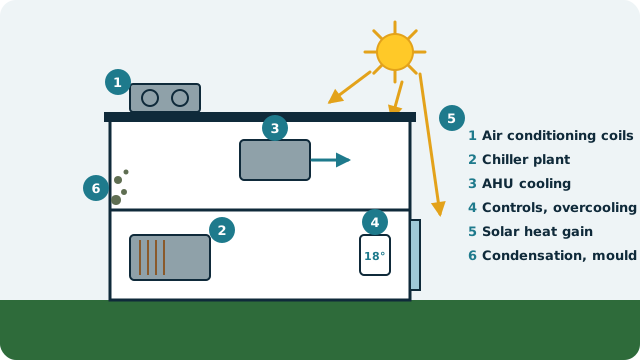
| Cause of loss | What you notice | Learn more | How it is fixed |
|---|---|---|---|
| Coil corrosion and fouling | Rising bills, longer compressor runtime, falling EER/COP | Inefficient air conditioning | Radiant+ E3 coil coating |
| Oil fouling in refrigerant circuits | Poor evaporator heat transfer, high discharge pressure | Chiller problems | MaxR100 refrigerant enhancer |
| Low chilled-water heat transfer | Unstable Delta-T, chillers working near capacity | Heat transfer loss | Aquene graphene heat transfer fluid |
| Restricted AHU airflow | Warm spots, fans at high speed, humidity complaints | AHU cooling efficiency loss | Coil restoration |
| Poorly tuned controls | Overcooled spaces, chillers cycling or running in parallel needlessly | Under-optimised HVAC operations | AI HVAC optimisation |
| Solar heat gain | Hot roofs, west-facing rooms that never cool down | Solar heat gain in buildings | Passive cooling and UV window film |
| Condensation and mould | Damp walls, odours, biofouled coils and ducts | Condensation mould | Anti-mould paint |
| Incomplete diesel combustion | Soot, carbon build-up, high fuel use | Incomplete combustion of diesel | Rentar Fuel Catalyst |
How does RCT approach an energy efficiency project?
We work as an engineering partner, not a product vendor. Every project starts with measurement and ends with verified results.
Diagnose
Site survey and data logging to find where heat transfer, airflow, control or combustion is losing energy.
Design
Choose the right fix for each loss, from coil coating to AI controls, with a costed savings and payback model.
Deploy
Install with minimal downtime. Shutdowns are scheduled with the owner; one crew coats 4–6 coils a day.
Verify
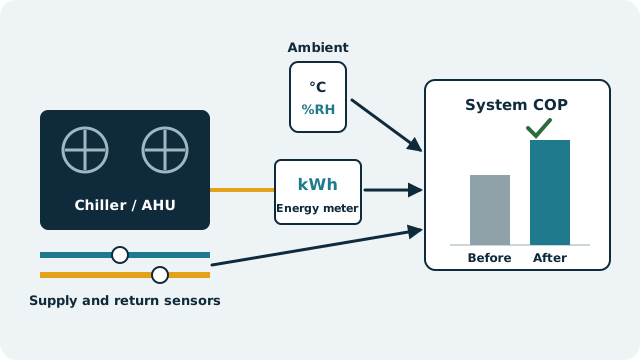
Energy meter, thermo-hygrometer and supply/return sensors compare system COP before and after against ambient.
Which energy efficiency solutions does RCT offer?
Four groups of technology, each matched to a type of loss. See every option on the solutions page, or use the HVACR efficiency enhancement guide to pick by system.
Thermal performance and heat transfer
Restore the heat transfer your HVACR plant was designed for.
- Radiant+ E3 Coating SystemWater-based, VOC-free coil coating for aluminium and copper heat exchangers.
- MaxR100 Refrigerant Performance EnhancerKeeps refrigerant circuits clean and flowing efficiently.
- Aquene heat transfer fluidGraphene-based nanofluid that raises chilled-water thermal conductivity.
AI cooling and operational optimisation
Run chillers, pumps and fans to real demand.
- AI-driven HVAC optimisation systemOptimises chiller plant operation for energy management.
- High-efficiency refrigerationRemoves unnecessary refrigeration waste.
Building envelope and indoor hygiene
Cut heat gain and stop condensation and microbial growth.
- Passive cooling for buildingsPENTAGUARD ceramic heat-shielding coating for roofs, walls and façades.
- Anti-mould paint for wallsAXION25 interior coating that prevents condensation and mould.
- UV window filmCeralite high-transparency heat and UV control film.
Diesel fuel efficiency
For fleets, generators and heavy plant.
- Rentar Fuel CatalystPromotes more complete combustion: less fuel, fewer emissions, less carbon build-up.
What results does Radiant+ E3 deliver?
Radiant+ E3 is a direct-to-metal, water-based coating applied to cleaned HVACR coils. It forms an ultra-thin, super-hydrophobic layer that lowers thermal resistance, smooths corroded fins for better airflow and sheds condensate before it can insulate the coil.
The result is shorter compressor runtime, lower discharge pressure, less fan power and a higher EER/COP.
- 10–25%
- HVAC electricity reduction, depending on system type and condition
- 12–24 months
- Typical payback from energy saved
- +3–5 years
- Average extension of HVAC asset life
- 0.3–0.9 t
- CO₂ avoided per system per year, on average
- 10–15 µm
- Coating thickness; expected to last more than 5 years
Figures as stated for the Radiant+ E3 Coating System. Your result depends on your plant; we measure it before and after.
Measured in real projects
- 18.5% less energy — supermarket, Dubai: seven rooftop units, 22,113 kWh saved in 147 days. Case study
- 22.5% less energy per day — office, Petaling Jaya, Malaysia: DX split unit. Case study
- +12.5% efficiency recovered on a corroded coil — independent accredited laboratory, Australia. Case study
- 28% less energy — school campus chiller, Gold Coast, Australia. All results
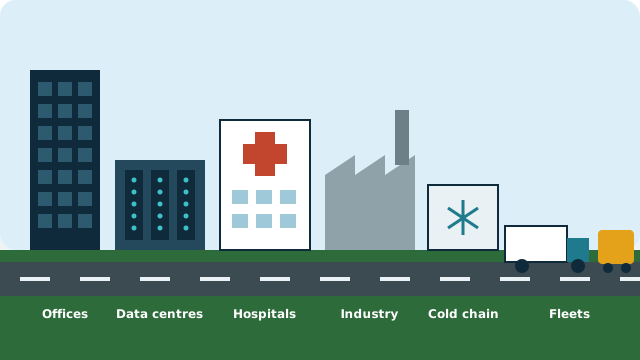
Which industries does RCT work with?
Any operation where cooling, refrigeration or diesel is a large share of running cost. See all industries.
What engineering-led services does RCT provide?
Technology only pays when the project is scoped, funded and measured properly. About our services.
Energy efficiency consulting
HVAC performance and cooling analysis, envelope and passive cooling review, industrial heat transfer evaluation, and a practical optimisation roadmap based on measured data.
Government grant advisory
We identify Singapore energy efficiency, green building and decarbonisation schemes that fit your project, align the scope to eligibility, and prepare the technical documentation.
Project planning consultancy
From concept to implementation: scope and engineering objectives, stakeholder coordination, deployment support and preparation for certification or grant approval.
Working with facilities management companies and HVAC contractors
If you maintain buildings for owners, RCT gives you the engineering and the tools to turn routine maintenance into a funded efficiency project.
Partner tools
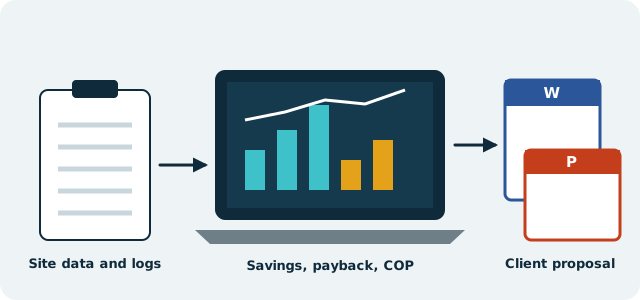
- HVAC Efficiency Improvement Project Dashboard: turns site data into a costed efficiency proposal with chiller and energy calculations, payback analysis and a library of over 1,600 chiller models.
- Energy Analysis Dashboard: upload Excel energy logs to chart energy, power and efficiency, compare stages, and export to PowerPoint or Word.
- HVACR Efficiency Enhancement Guide: select the right technology for each part of an HVACR system.
- The Road to Net Zero: our free book on turning a property into a high-performance, low-carbon asset.
Frequently asked questions
Each answer has its own page; see all HVAC energy questions.
What does Radiant Climate Technologies do?
Radiant Climate Technologies (RCT) is a Singapore energy efficiency consulting and thermal engineering company. We diagnose where buildings, cooling plants, refrigeration and diesel fleets lose energy, then cut it with HVAC heat-transfer technologies, AI HVAC optimisation, smart LED lighting, heat-shielding envelope coatings, window film, building energy management and solar. We also advise on government sustainability grants.
How much energy can coating HVAC coils save?
For the Radiant+ E3 Coating System, the stated HVAC electricity saving is 10–25%, depending on system type and condition, with a typical payback of 12–24 months from the energy saved.
Do I need to replace my chiller or air-conditioning equipment to save energy?
No. Our approach restores the efficiency that existing equipment has lost to corrosion, fouling, water retention and poor control settings. A shutdown is needed while coils are coated, and we schedule it with you. One crew can coat 4–6 fin coils of up to 3 m² each, both sides, in an 8-hour day, working from the ground.
How are energy savings measured and verified?
We install a Wi-Fi or cellular energy meter on the system's power supply, a thermo-hygrometer for ambient conditions, and sensors on supply and return air (for coil heat transfer) or chilled water (for cooling load). System COP is then compared before and after, against ambient temperature.
How long does the Radiant+ E3 coating last?
It is expected to last more than 5 years, and to extend average HVAC asset life by 3–5 years.
Can Singapore government grants help pay for energy efficiency upgrades?
Often, yes. Our grant advisory identifies suitable schemes, aligns your project scope with the eligibility criteria, and prepares the technical documentation and performance verification that applications need.
Find out how much energy your building is losing
Tell us about your chiller plant, AHUs, refrigeration or fleet. We will suggest what to measure first, and whether a grant could fund the work.
- Emailenquiries@radiantct.com
- WhatsApp+65 8068 3147
- Office12 Woodlands Square, #13-79 Woods Square Tower 1, Singapore 737715